


OCD Therapy in Pittsburgh, PA
My approach integrates evidence-based treatments including Inference-Based CBT (ICBT), Exposure and Response Prevention (ERP), Attention Training Technique (ATT), Acceptance and Commitment Therapy (ACT), EMDR when clinically appropriate, mindfulness, and somatic skills.

OCD Isn't Trying to Tell You the Truth — It's Trying to Convince You to Doubt It
If you've ever thought "What if?" "Are you sure?" "But what if this time is different?" — you're not alone, and you're not "crazy." OCD isn't a disorder of dangerous thoughts. It's a disorder of doubt. It convinces you that possibility deserves more attention than reality, leaving you questioning your thoughts, your memories, your intentions — even the things you value most.
The good news: OCD is one of the most treatable mental health conditions when it's understood correctly. Together, we'll help you step out of OCD's bubble, rebuild trust in your own mind, and get back to the life OCD has been asking you to put on hold.

Virtual OCD Therapy Throughout Pennsylvania
What Is OCD?
OCD (Obsessive-Compulsive Disorder) is a cycle of unwanted intrusive thoughts, images, urges, or doubts (obsessions) followed by mental or physical behaviors (compulsions) meant to reduce anxiety or find certainty.
The relief is only temporary, which keeps the cycle going.
At its core, OCD isn't about the content of the thoughts—it's about the brain becoming stuck searching for certainty in situations where certainty isn't possible.

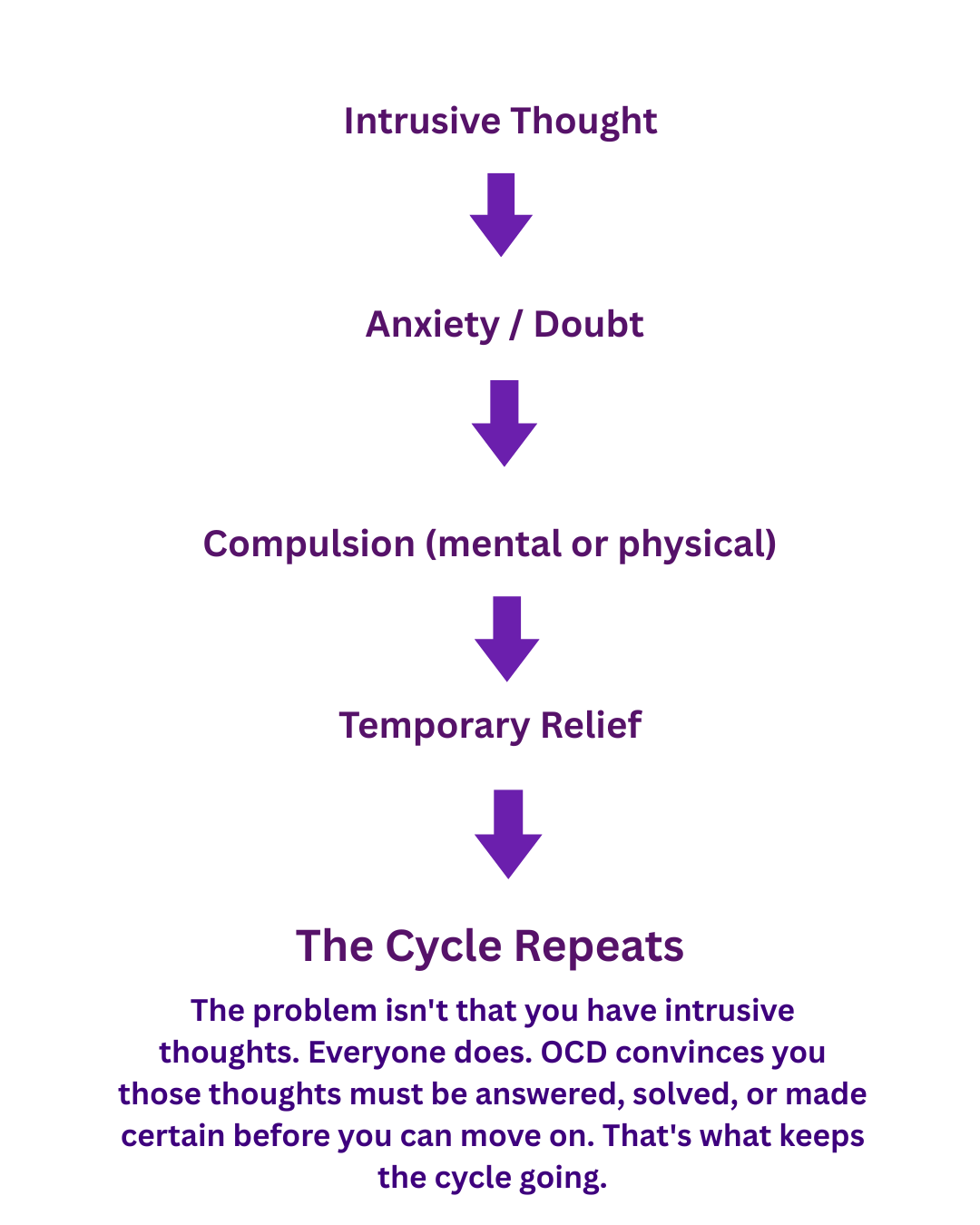
Compulsions bring temporary relief—but they also teach the brain that the obsession was important and needed to be solved. Over time, this strengthens the OCD cycle rather than breaking it.
🧠 Why Is It So Hard to "Just Let It Go?"
The neuroscience behind OCD—explained simply.
Researchers don't yet know the exact cause of Obsessive-Compulsive Disorder (OCD), but one leading theory helps explain why intrusive thoughts can feel so persistent.
Instead of recognizing a thought as unimportant and moving on, the brain keeps sending the message:
"Pay attention. This still needs to be solved."
That doesn't mean the thought is true.
It doesn't mean it's dangerous.
It simply means your brain is having trouble switching the signal off.
This short, two-minute video explains the process beautifully, and it's one I share with almost every OCD client.
Understanding OCD is the first step. Learning how to respond to it differently is where healing begins.
OCD Attacks the Things You Value Most
One of the cruelest things about OCD is that it doesn't usually attack the things you don't care about.
It attacks the things you value most.
If you deeply value your children...
OCD may convince you you're dangerous.
If you deeply value your relationship...
OCD may convince you that you're with the wrong person.
If your faith is important...
OCD may convince you you've committed an unforgivable sin.
If you're a compassionate person...
OCD may convince you you're secretly cruel.
If you're an honest person...
OCD may convince you you're lying.
The content of the obsession changes.
The mechanism stays remarkably similar.
OCD doesn't target your weaknesses.
It targets your values.
That's what makes it feel so convincing.
And that's also why the thoughts feel so upsetting.
Because they don't reflect who you are.
They reflect what matters to you.
Read that again.

This is important.
The fact that a thought feels disturbing is often evidence that it conflicts with your values—not that it reflects your intentions.
The OCD Bubble
One of the ways I explain OCD is through something I call the OCD Bubble.
When OCD takes over, your world starts getting smaller.
Reality fades into the background, and "what if?" becomes more important than "what is."
Inside the bubble, your brain searches for certainty, reassurance, proof, and answers.
The hardest part?
Leaving the bubble can feel irresponsible—even dangerous.
OCD says things like:
"Google it one more time."
"Ask ChatGPT."
"Don't move on until you're 100% certain."
But OCD is almost never satisfied with certainty.
The moment you answer one question, it asks another.
That's why OCD treatment isn't about proving every fear wrong.
It's about stepping out of the bubble, reconnecting with reality, and rebuilding trust in your own common sense—so when you see the stove is off, you can trust yourself the first time and simply walk away.

The Things OCD Clients Are Most Afraid to Tell Me
If you've ever thought...
"I can't tell anyone this."
I want you to know something.
You are not alone.
Here are just a few of the things clients have worried about before learning how OCD works:
• "What if I'm secretly a bad person?"
• "What if I actually want these thoughts?"
• "What if I'm dangerous?"
• "What if I hurt someone and don't remember?"
• "What if I'm lying to my therapist?"
• "What if I'm making all of this up?"
• "What if I don't actually have OCD?"
• "What if I answered the assessment questions wrong?"
• "What if I accidentally exaggerated my symptoms?"
• "What if I'm just looking for attention?"
• "What if I'm manipulating everyone?"
• "What if I never figure this out?"
• "What if treatment doesn't work because I'm different?"
If you're nodding your head while reading these...
You're not alone.
And you won't shock me. I’ll be honest, most people think they are telling me something I’ve never heard of or worse that I will report them.
One of the greatest gifts I can offer people with OCD is a space where they no longer have to hide from the very thoughts they've been terrified to say out loud.
Because thoughts are not actions.
Thoughts are not intentions.
And having an intrusive thought says remarkably little about the kind of person you are.

You don't have to protect me from your OCD.
I've worked with enough OCD to know that intrusive thoughts are often the very opposite of what someone wants, values, or intends.
You are welcome here.
Yes...OCD Can Even Make You Doubt That You Have OCD
One of the most confusing parts of OCD (Obsessive-Compulsive Disorder) is that it doesn't stop once you recognize it.
Instead, OCD often finds a new source of doubt.
After learning about OCD, the questions may change:
What if I don't actually have OCD?
What if I'm making this up?
What if my therapist is wrong?
What if I answered the assessment incorrectly?
What if this treatment won't work for me?
OCD doesn't just create intrusive thoughts. It creates doubt about your diagnosis, your therapist, your memories, your progress, and even your recovery.
That's because OCD isn't attached to one specific fear.
It's attached to uncertainty.
As one obsession loses its grip, OCD often searches for another.
Recognizing this pattern is an important part of OCD treatment. It reminds you that just because the question changed doesn't mean it stopped being OCD.
Did You Know?
Most people experience intrusive, bizarre, or unwanted thoughts from time to time.
A random image.
A disturbing "what if?"
What if I push someone in front of the train?
What if I harm my child or partner?
What if I shout something inappropriate at church or work?
Research shows these kinds of thoughts are surprisingly common.
The difference isn't that people without OCD never have them.
It's that they don't get hooked by them.
Someone without OCD might think,
"Well...that was weird."
...and move on.
Someone with OCD is often pulled into answering the thought.
Why did I think that?
What does this say about me?
What if I secretly want it?
What if I'm the exception?
Before long, the thought isn't just a thought anymore.
It becomes a question that feels urgent to solve.
One of OCD's greatest tricks is convincing you that every intrusive thought deserves your attention.
One of the most freeing parts of OCD treatment is realizing...
It doesn't.
You don't have to answer every thought.
You don't have to investigate every fear.
And you don't have to prove who you are to OCD.
One of the first signs that you're beginning to understand OCD...
...is realizing that OCD will often try to convince you that everything you've just learned couldn't possibly apply to you.
If you've ever caught yourself thinking...
"This makes sense...but what if I'm the exception?"
You're not alone.
If This Finally Makes Sense...
Let's Talk About What's Next.
My goal is to help you stop treating every intrusive thought like it deserves an investigation.
Not...Stop thinking. Not...Get rid of thoughts.
But...Stop believing every thought deserves to be solved.
The thought isn't the problem.
The relationship with the thought is.
Why Won't the Thought Go Away?
One of the most validating things I tell my OCD clients is this:
Just because a thought keeps coming back doesn't mean it's important.
It means your brain has become very good at replaying that particular message.
One leading neuroscience theory suggests that OCD affects the brain's ability to filter out unwanted thoughts and switch them off. Instead of letting a thought come and go, the brain gets "stuck," replaying it over and over.
Many people think,
"If I keep having this thought, it must mean something."
But with OCD, the repetition isn't evidence that the thought is true.
It's evidence that your brain has become stuck replaying it.
One of the most freeing parts of OCD treatment is realizing you don't have to prove the thought wrong.
You simply have to recognize what it is:
An overactive brain sending the same false alarm—again and again.

Repetition does not equal importance.
One of OCD's favorite tricks is convincing you that because a thought keeps returning...
...it deserves another investigation.
The truth is...
Repetition does not equal importance.
It reflects a brain that has become stuck replaying the same message—not a thought that deserves more of your attention.
One of the things I've consistently noticed while treating OCD is this:
The person terrified they'll harm their baby is often the person who loves their child most.
The person afraid they'll hit someone while driving is often someone who deeply values safety.
The person questioning whether they're "good enough" is often someone who cares deeply about doing the right thing.
OCD doesn't create these thoughts because they reflect your character.
It often latches onto the things you value most.
Those thoughts aren't evidence that you'll do something terrible.
They're often evidence that what you're afraid of matters deeply to you.
Mental Compulsions: The OCD Nobody Talks About
When most people think of OCD...
They picture handwashing.
Checking locks.
Or organizing things perfectly.
While those compulsions certainly exist...
Many people with OCD perform compulsions that no one else can see.
They're called mental compulsions.
Because they're invisible, they're often misunderstood—even by the people experiencing them.
Mental compulsions can include:
• Mentally reviewing conversations
• Replaying memories
• Checking your feelings
• Trying to "figure it out"
• Reassuring yourself
• Mentally arguing with OCD
• Repeating phrases or prayers
• Searching for certainty
• Comparing yourself to others
• Constantly analyzing whether something "felt right"
These compulsions usually begin with one goal:
To make the anxiety go away.
Ironically...
The more we answer OCD's questions...
The more questions it creates.
Understanding mental compulsions is often one of the biggest turning points in treatment because people finally realize:
"I'm not just having obsessions...I've been responding to them in ways I never realized."

Invisible doesn't mean less real.
Mental compulsions can be just as exhausting as physical compulsions.
Sometimes even more so.
Because there are no outward behaviors for others to see.
Curious about the many forms mental compulsions can take? I love this resource from ACT Beyond OCD because it illustrates just how invisible—and exhausting—mental compulsions can be.
You're Not the Only One
One of my favorite moments during an OCD evaluation happens before therapy has even begun.
It's when we complete a structured assessment together.
As we walk through common OCD symptoms and experiences, I often watch people visibly relax.
Sometimes they laugh.
Sometimes they cry.
Sometimes they simply say...
"I thought I was the only one."
You're not.
One of the cruelest parts of OCD is how isolating it feels.
It convinces people they're uniquely broken.
Uniquely dangerous.
Uniquely confusing.
The truth is...
OCD is remarkably good at making people believe they're the exception.
One of the first steps in healing is realizing...
You're not.

It's Not About Getting Rid of Every Thought
When people first begin OCD therapy, it's completely understandable to hope the intrusive thoughts will disappear.
After all, most people have been suffering for months—or even years—before they seek treatment.
I understand why that's the goal.
Ironically...
That's usually not where lasting healing happens.
My goal isn't to help you win every argument with OCD.
Because OCD always has another question.
Another "what if?"
Another reason to doubt.
Instead, our work is about helping you recognize OCD's patterns more quickly, rebuild trust in your own common sense, and reconnect with the life OCD has been asking you to put on hold.
Because treatment isn't just about having fewer intrusive thoughts.
It's about getting your life back. Traveling again.
Driving again.
Changing your child's diaper without fear.
Going back to church.
Enjoying your hobbies.
Sleeping peacefully.
Making decisions without needing absolute certainty.
Starting the business you've been putting off.
Laughing with your family without OCD interrupting every moment.
The goal isn't simply to reduce OCD symptoms.
It's to help you get your life back.
We don't measure success by how quiet OCD becomes.
We measure it by how fully you're able to live your life again.
What Working Together Might Look Like
Every person who comes to therapy has a different story.
Different goals.
Different experiences.
Different ways OCD shows up.
That's why our first sessions are spent getting to know you—not just your symptoms.
Together, we'll identify:
✓ How OCD shows up in your life
✓ The situations that keep it going
✓ The mental or behavioral compulsions that may be maintaining the cycle
✓ Your strengths and values
✓ The approaches that are likely to fit you best
As therapy progresses, we'll continue adjusting your treatment based on what's working—not on a rigid formula.
Because therapy should fit the person.
Not the other way around.
My goal isn't to fit you into a treatment model.
It's to build a treatment plan that fits you.
Evidence-Based OCD Treatment Tailored to You
There isn't one "right" way to treat OCD.
Because every person's OCD looks a little different, I build treatment plans using evidence-based approaches that fit your symptoms, goals, strengths, and nervous system.
Depending on your needs, treatment may include:
✓ Inference-Based CBT (ICBT) – Helping you recognize OCD's faulty reasoning and rebuild trust in reality.
✓ Exposure and Response Prevention (ERP) – Learning to respond differently to uncertainty without relying on compulsions.
✓ Attention Training Technique (ATT) – Strengthening your ability to shift attention rather than becoming locked onto intrusive thoughts.
✓ Acceptance and Commitment Therapy (ACT) – Learning to make room for uncertainty while moving toward what matters most.
✓ EMDR(when clinically appropriate) – Addressing trauma or experiences that may continue influencing the way your brain and nervous system respond.
✓ Somatic Skills – Helping your nervous system experience safety and support through body-based regulation strategies.
✓ Mindfulness – Strengthening awareness without becoming pulled into OCD's stories.
✓ Narrative Therapy – Helping you separate your identity from OCD and rewrite the story OCD has been telling about you.
You don't have to figure OCD out before coming to therapy.
That's what we'll do together.

Your Trusted OCD Therapist
Living with OCD can feel incredibly isolating.
Many people spend years wondering if anyone will understand what they're experiencing—or worrying that saying their thoughts out loud will change the way someone sees them.
I don't take that trust lightly.
My role isn't to judge your thoughts.
It's to help you understand how OCD works, recognize its patterns, and build confidence in your ability to respond differently.
My approach integrates evidence-based treatments including Inference-Based CBT (ICBT), Exposure and Response Prevention (ERP), Attention Training Technique (ATT), Acceptance and Commitment Therapy (ACT), EMDR when clinically appropriate, mindfulness, and somatic skills.
Most importantly...
I believe therapy should be collaborative.
Curious.
Compassionate.
And tailored to the individual sitting across from me.
No two people experience OCD in exactly the same way.
Your treatment shouldn't be one-size-fits-all either.
Ready to stop letting OCD make your decisions?
You don't have to keep living inside OCD's bubble.
Let's work together to help you rebuild trust in yourself—and reconnect with the life that's waiting for you.
Individual Therapy - $165 per session
If you have out-of-network benefits, your insurance may reimburse a portion of your therapy costs
I've partnered with Mentaya to make checking your benefits quick and easy.
Use the tool below to see whether you qualify for reimbursement and what your estimated coverage may be.